

- October 13, 2025
- Posted by: Intesar Husain
- Category: Blog
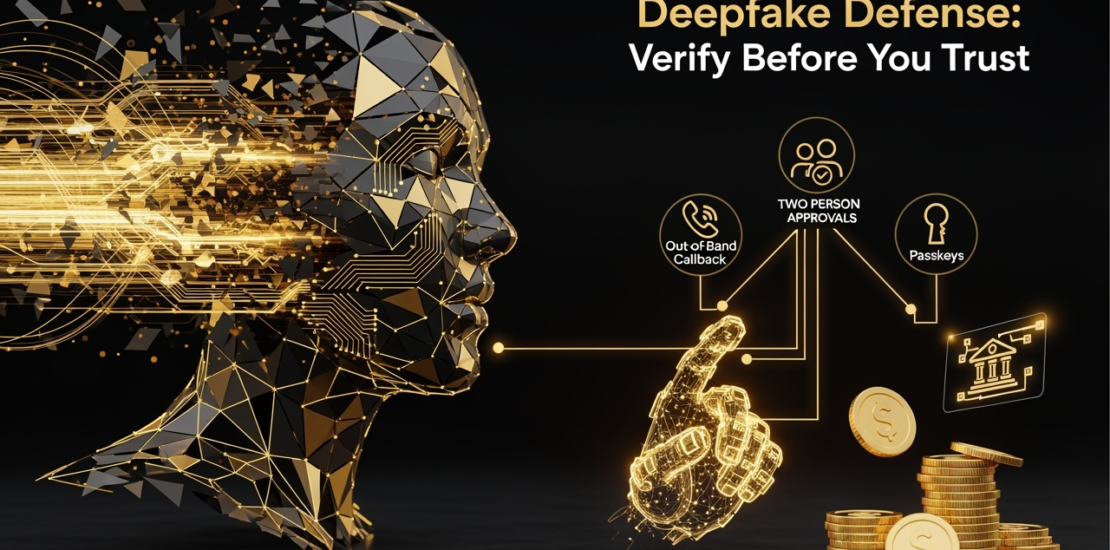
Deepfakes have evolved from novelty to a real operational and financial risk, that’s now front and center for CISOs, CFOs, and insurance carriers alike. In Part 1, we explored how attackers are using AI-generated voices, videos, and text to supercharge social engineering. This week, we go deeper, unpacking the latest deepfake trends, their impact on financial fraud, and the new insurance realities every business leader needs to know.
Emerging Deepfake Trends (and Their Financial/Insurance Impact)
- Real-time voice morphing & context-aware fakes: Attackers now use live voice-morphing and internal lingo to impersonate executives or vendors. The insurance angle? These tactics are driving a surge in fraudulent payment instructions, successful wire fraud, and unauthorized access, triggering cyber, crime, and fidelity policy claims.
- Multi-channel, high-volume attacks: Deepfakes now layer audio, video, and AI-generated text across email, phone, and video calls. Carriers are watching for organizations that can prove multi-factor authentication (MFA) and out-of-band verification for sensitive transactions or credential changes.
- AI-powered phishing: Large language models mimic executive writing styles, making targeted emails and texts almost indistinguishable from the real thing. Insurers are tightening requirements for staff training, documented verification procedures, and regular simulation drills.
- Volume over perfection: Attackers prioritize speed and scale, targeting dozens of organizations at once, especially SMBs. As Swiss Re highlights, deepfakes are now being used to manipulate claims evidence, raising the bar for documentation and scrutiny during the claims process.
Business Impact Patterns & Insurance Consequences
- Wire fraud & payment scams: Deepfaked voices or videos “approve” urgent transfers, bypassing weak controls. Insurers now expect to see proof of callback verification and two-person approvals for high-value transactions. Without these, claims may be delayed or denied.
- IT & security overrides: Fake admin requests for password resets or MFA bypasses can lead to data breaches or ransomware. Coverage may hinge on whether phishing-resistant MFA and privileged access management were in place.
- Reputation & PR risk: Faked statements or videos can trigger regulatory scrutiny, shareholder lawsuits, or public relations crises, impacting D&O and E&O coverage.
- Claims fraud: Synthetic media can be used to submit false claims (e.g., staged incidents, manipulated “evidence”). Insurers are investing in deepfake detection and may deny claims lacking robust, verifiable documentation.
Defenses That Matter, For Security and Insurance
- Out-of-band verification: Every payment or access change should require a callback to a known number. No exceptions. Insurers increasingly require this as a condition for social engineering and cyber coverage.
- Two-person rule: Sensitive actions must be independently approved by two people, ideally from different departments. This is becoming a standard underwriting question.
- Phishing-resistant MFA: Move all admins and finance users to FIDO2/passkeys; phase out SMS and basic auth. Carriers may exclude losses if MFA isn’t enforced for finance/admin roles.
- Just-in-time access: Grant admin rights only when needed; audit privileged actions regularly. Insurers look for privileged access management in underwriting and claims reviews.
- Verification scripts & training: Equip staff with scripts for declining suspicious requests and provide quarterly deepfake/social engineering training. Insurers may request training logs during claims or renewal.
- Evidence preservation: Keep a robust “evidence binder” consisting of screenshots, logs, emails, call metadata, and training records, to support any future claim and speed up the process.
Incident Playbook: What Your Policy Will Want to See
- Immediate reporting path for suspected deepfakes.
- Containment steps (freeze payments, rotate credentials, alert stakeholders).
- Evidence preservation (save all media, logs, and metadata).
- Notification protocols (vendors, customers, regulators).
- Documentation—the more you can prove, the smoother your claim and renewal process.
Tool Landscape (Not Endorsements)
- Detection: Reality Defender, Hive Moderation, Microsoft Video Authenticator, Intel FakeCatcher, Pindrop, Nuance Gatekeeper.
- Training: Adaptive Security, Cofense, KnowBe4 (with deepfake modules).
- Identity and access: Okta, Microsoft Entra, Duo (passkeys); CyberArk, BeyondTrust, Delinea (JIT access).
Future Outlook: Insurance and Deepfakes
- Carriers are adapting: Expect more detailed underwriting on synthetic media risk, verification controls, and staff readiness.
- Potential exclusions: Policies may begin to exclude “synthetic media” fraud if you can’t demonstrate robust controls.
- Provenance tools (C2PA, watermarking): These will help, but internal verification and evidence remain decisive for claims.
Source: Swiss Re – How deepfakes, disinformation and AI amplify insurance fraud
Checklist to Deploy This Week
- Enforce out-of-band callbacks and two-person rule for payments/access changes.
- Move high-risk users to FIDO2/passkeys; audit privileged accounts.
- Issue a “verify or decline” script; add callback numbers to signatures.
- Schedule a deepfake drill within 30 days.
- Publish official channels and a media registry; set up a verification inbox.
- Require vendors to follow your verification standards.
- Maintain an “evidence binder” for claims support.
Bottom Line
Deepfakes are changing both the threat and the insurance landscape. The more you can prove controls, readiness, and documentation, the stronger your position for resilience, clean claims, and better renewals. Technical controls and insurance hygiene now go hand in hand.
Need a quick deepfake resilience checkup or our Deepfake Response Checklist? Book a 30-minute session or reply below.
📧 Contact Us Today: marketing@disrisksolutions.com
🌐 Learn More: https://disrisksolutions.com
Prepare. Protect. Prevail.
#InsiderRisk #CyberInsurance #Compliance #CyberResilience #TalentManagement #DISRiskSolutions #ZeroDayIntelligence